
AAA Battery Voltage:
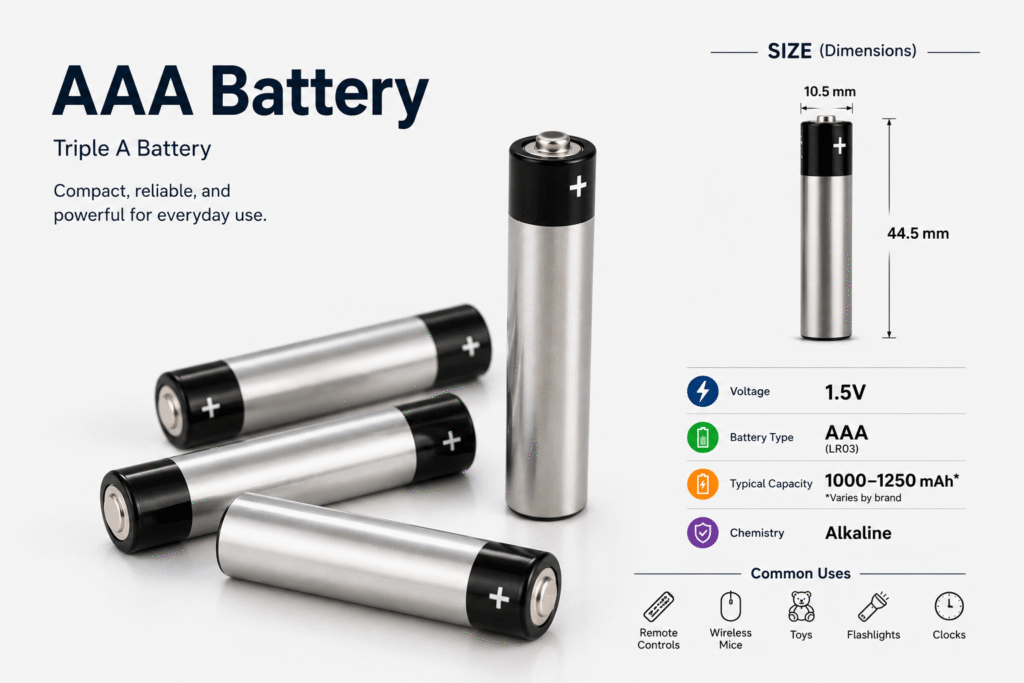
A standard alkaline AAA battery has a nominal voltage of 1.5 V, while a rechargeable NiMH AAA battery has a nominal voltage of 1.2 V. The voltage of a AAA battery is the electrical potential it provides to power a device. As the battery discharges, its voltage gradually decreases, reducing its ability to supply power effectively.
Definition Of an AAA Battery:
An AAA battery is a standardized dry-cell battery with a diameter of 10.5 mm and a length of 44.5 mm. It is commonly used in low- to medium-power electronic devices such as remote controls, wireless mice, clocks, flashlights, and toys. AAA batteries are available in various chemistries, including alkaline, lithium, and rechargeable nickel-metal hydride (NiMH).
Types of AAA Batteries
AAA batteries are commonly classified into two categories by its recharge computability, One is Non-Rechargeable (Primary) and Rechargeable (Secondary) batteries.
1. Non-Rechargeable AAA Batteries (Primary)
These batteries are designed for single use and must be replaced once discharged.
• Alkaline AAA Batteries
- Nominal Voltage: 1.5 V
- Chemistry: Zinc–Manganese Dioxide (Alkaline)
- Best For: Remote controls, clocks, flashlights, wireless mice, and TV remotes.
- Advantages:
- Affordable and widely available
- Long shelf life (5–10 years)
- Reliable for low- to medium-drain devices
- Limitations:
- Cannot be recharged
- Performance declines in high-drain applications
• Lithium AAA Batteries
- Nominal Voltage: 1.5 V
- Chemistry: Lithium Iron Disulfide (Li-FeS₂)
- Best For: Digital cameras, smart locks, medical devices, and outdoor electronics.
- Advantages:
- Higher energy density and longer runtime
- Lightweight
- Excellent performance in extreme temperatures
- Shelf life of up to 20 years
- Limitations:
- More expensive than alkaline batteries
- Not rechargeable
• Carbon-Zinc AAA Batteries
- Nominal Voltage: 1.5 V
- Chemistry: Zinc–Carbon
- Best For: Low-power devices such as wall clocks, calculators, and remote controls.
- Advantages:
- Low cost
- Suitable for occasional use
- Limitations:
- Lower capacity than alkaline batteries
- Shorter lifespan
- Poor performance in high-drain devices
2. Rechargeable AAA Batteries (Secondary)
These batteries can be recharged and reused hundreds to thousands of times, making them cost-effective and environmentally friendly.
• Nickel-Metal Hydride (NiMH) AAA Batteries
- Nominal Voltage: 1.2 V
- Best For: Wireless keyboards, gaming controllers, cameras, toys, and other frequently used devices.
- Advantages:
- Rechargeable up to 500–1,000+ cycles
- High capacity and stable voltage output
- Environmentally friendly
- Limitations:
- Lower nominal voltage than alkaline batteries
- Requires a compatible battery charger
• Lithium-Ion (Li-ion) AAA Batteries
- Output Voltage: Typically regulated to 1.5 V
- Chemistry: Lithium-Ion with built-in voltage regulation
- Best For: High-performance electronics requiring consistent voltage.
- Advantages:
- Consistent 1.5 V output throughout discharge
- Fast charging
- Long cycle life (500–1,000+ recharge cycles)
- High energy density
- Limitations:
- Higher initial cost
- Requires a dedicated Li-ion charger or USB charging system
Comparison of an AAA battery Voltage at a Glance:
| Category | Battery Type | Nominal Voltage | Rechargeable | Best Application |
|---|---|---|---|---|
| Primary | Alkaline | 1.5 V | ❌ | General household devices |
| Primary | Lithium | 1.5 V | ❌ | High-drain and extreme environments |
| Primary | Carbon-Zinc | 1.5 V | ❌ | Low-power, occasional-use devices |
| Secondary | NiMH | 1.2 V | ✅ | Frequently used electronic devices |
| Secondary | Lithium-Ion | 1.5 V (regulated) | ✅ | High-performance electronics |
Key Point: Non-rechargeable (primary) triple A batteries are intended for one-time use and are ideal for infrequently used devices, while rechargeable (secondary) triple A batteries can be reused many times, making them a more economical and environmentally sustainable choice for devices used regularly.
AAA Battery Capacity, Performance, and Leading Manufacturers
The capacity of a AAA battery is measured in milliampere-hours (mAh) and indicates how much electrical charge the battery can store. A higher capacity generally means a longer operating time, although actual performance depends on the device’s power consumption and the battery chemistry.
| Battery Type | Typical Capacity | Performance | Common Manufacturers |
|---|---|---|---|
| Alkaline AAA | 900–1,200 mAh | Good for low- to medium-drain devices; long shelf life (5–10 years). Voltage gradually decreases during use. | Duracell, Energizer, Panasonic, GP Batteries, Rayovac |
| Lithium AAA (Li-FeS₂) | 1,200–1,350 mAh | High energy density, lightweight, excellent in extreme temperatures (-40°C to 60°C), and up to 20-year shelf life. | Energizer, Panasonic, EBL |
| Carbon-Zinc AAA | 400–800 mAh | Lowest capacity and shortest lifespan; suitable only for low-power, occasional-use devices. | Panasonic, GP Batteries, Eveready |
| NiMH Rechargeable AAA | 600–1,100 mAh | Delivers stable 1.2 V output and supports 500–1,000+ recharge cycles. Best for frequently used devices. | Panasonic (Eneloop), Energizer, Duracell, IKEA (LADDA), Amazon Basics |
| Li-ion Rechargeable AAA (1.5 V Regulated) | 600–1,000 mAh (typically 300–500 mAh at 3.7 V internally) | Provides a constant 1.5 V output, fast charging, and 500–1,000+ recharge cycles. Ideal for high-performance electronics. | XTAR, EBL, TENAVOLTS, Pale Blue Earth |
How to Choose the Best AAA Battery for you?
Selecting the right AAA battery depends on your device’s power requirements, usage frequency, budget, and environmental conditions. No single battery type is best for every application.
1. For Everyday Household Devices
Choose Alkaline AAA batteries if your device consumes low-drain to moderate power, such as:
- TV remotes
- Wall clocks
- Wireless mice
- Flashlights
- Toys
Why choose it?
- Affordable and widely available
- Long shelf life (5–10 years)
- Reliable for general-purpose applications
2. For High-Performance or High-Drain Devices
Choose Lithium AAA batteries for devices that require maximum power, higher voltage and long operating time, including:
- Digital cameras
- Smart locks
- Medical devices
- Outdoor electronics
- Emergency equipment
Why choose it?
- Highest energy density
- Longest runtime
- Excellent performance in extreme temperatures
- Lightweight with up to 20-year shelf life
3. For Frequently Used Devices
Choose NiMH Rechargeable AAA batteries if you regularly replace batteries in devices such as:
- Gaming controllers
- Wireless keyboards and mice
- Rechargeable toys
- Camera flashes
Why choose it?
- Rechargeable 500–1,000+ times
- Lower long-term cost
- Environmentally friendly
- Stable performance throughout most of the discharge cycle
4. For Devices Requiring a Stable 1.5 V Output
Choose Lithium-Ion Rechargeable AAA batteries for electronics that are sensitive to voltage drops, including:
- Smart home devices
- Wireless accessories
- Specialized electronic equipment
Why choose it?
- Constant 1.5 V output
- Fast charging
- Long cycle life
- Consistent performance until nearly discharged
5. For Low-Cost, Low-Power Applications
Choose Carbon-Zinc AAA batteries only for simple devices with minimal power demands, such as:
- Basic clocks
- Calculators
- Simple remote controls
Why choose it?
- Lowest purchase cost
- Suitable for occasional use
Limitation: Shorter lifespan and lower capacity than alkaline batteries.
Quick Buying Guide
| If you need… | Best Choice |
|---|---|
| Best overall for everyday use | Alkaline AAA |
| Longest battery life | Lithium AAA |
| Best value over time | NiMH Rechargeable AAA |
| Constant 1.5 V performance | Lithium-Ion Rechargeable AAA |
| Lowest upfront cost | Carbon-Zinc AAA |
Final Recommendation
For most users, Alkaline AAA batteries are the best all-around choice because they offer a balance of cost, availability, and performance. If you use the same devices frequently, NiMH rechargeable batteries provide the greatest long-term savings and reduce environmental waste. For demanding applications where runtime, reliability, and temperature resistance are critical, Lithium AAA batteries are the premium choice despite their higher initial cost.
Storage, Maintenance, and Safe Disposal of AAA Batteries
Proper storage, maintenance, and disposal of triple A batteries are essential for maximizing battery life, ensuring reliable performance, and minimizing environmental impact. While maintenance requirements vary between rechargeable and non-rechargeable batteries, following the best practices below can significantly improve battery safety and longevity.
1. Storage of AAA Batteries
Proper storage helps preserve battery capacity and reduces the risk of leakage or premature failure.
Best Storage Practices
- Store in a cool, dry place with temperatures between 10°C and 25°C (50°F–77°F).
- Keep batteries in their original packaging or a dedicated battery storage case to prevent accidental short circuits.
- Avoid direct sunlight, excessive heat, and humidity, as these conditions accelerate battery degradation.
- Do not store batteries in metal containers where terminals may come into contact with coins, keys, or other metal objects.
- Keep batteries away from children and pets to prevent accidental swallowing.
- If storing batteries for an extended period, remove them from electronic devices to prevent leakage and corrosion.
Storage Tips by Battery Type
- Alkaline Batteries: Can be stored for 5–10 years under proper conditions.
- Lithium Batteries: Offer the longest shelf life, typically 10–20 years.
- Rechargeable NiMH Batteries: Store partially charged (about 40–60% charge) if they will not be used for several months.
- Rechargeable Li-ion AAA Batteries: Store at approximately 40–60% charge and recharge every 6–12 months during long-term storage.
2. Maintenance of AAA Batteries
Proper maintenance improves battery performance, extends service life, and reduces the risk of device damage.
General Maintenance Guidelines
- Do not mix old and new batteries in the same device.
- Avoid mixing different battery chemistries, such as alkaline with lithium or rechargeable batteries.
- Insert batteries with the correct polarity (+ and − terminals) as indicated by the device.
- Inspect batteries regularly for leakage, swelling, rust, or corrosion.
- Clean battery terminals gently with a dry cloth or cotton swab if dirt or oxidation is present.
- Remove batteries from devices that will not be used for an extended period.
Rechargeable Battery Maintenance
- Use only the charger recommended for the battery chemistry.
- Avoid overcharging by using chargers with automatic shut-off.
- Recharge batteries before they become completely discharged whenever possible.
- Do not expose rechargeable batteries to excessive heat during charging or use.
3. Safe Disposal of AAA Batteries
Improper disposal of batteries can release hazardous materials into the environment and may create fire hazards.
Disposal Guidelines
- Do not throw rechargeable batteries into household trash, as they contain materials that should be recycled.
- Recycle batteries through authorized collection or recycling programs whenever possible.
- Tape the battery terminals of lithium and rechargeable batteries before disposal to prevent short circuits during transport.
- Never burn or incinerate batteries, as they may explode or release toxic gases.
- Do not puncture, crush, or disassemble batteries.
- Follow local regulations for battery disposal and recycling.
Disposal by Battery Type
| Battery Type | Disposal Recommendation |
|---|---|
| Alkaline | Can often be disposed of with household waste where local regulations permit, but recycling is preferred. |
| Lithium (Primary) | Recycle through an approved battery collection program. |
| NiMH Rechargeable | Always recycle at an authorized battery recycling facility. |
| Li-ion Rechargeable | Must be recycled; never dispose of in regular household waste. |
| Carbon-Zinc | Dispose of according to local regulations; recycling is encouraged. |
Conclusion:
AAA batteries are compact, versatile power sources used in a wide range of electronic devices. Choosing the right battery depends on your application’s power requirements, usage frequency, and budget. Alkaline batteries are ideal for everyday use, lithium batteries provide superior performance and longer life for high-drain devices, while rechargeable NiMH and Li-ion batteries offer excellent long-term value and environmental benefits. By selecting the appropriate battery type and following proper storage, maintenance, and disposal practices, users can maximize battery performance, extend service life, and reduce environmental impact.