
What is an alkaline battery?
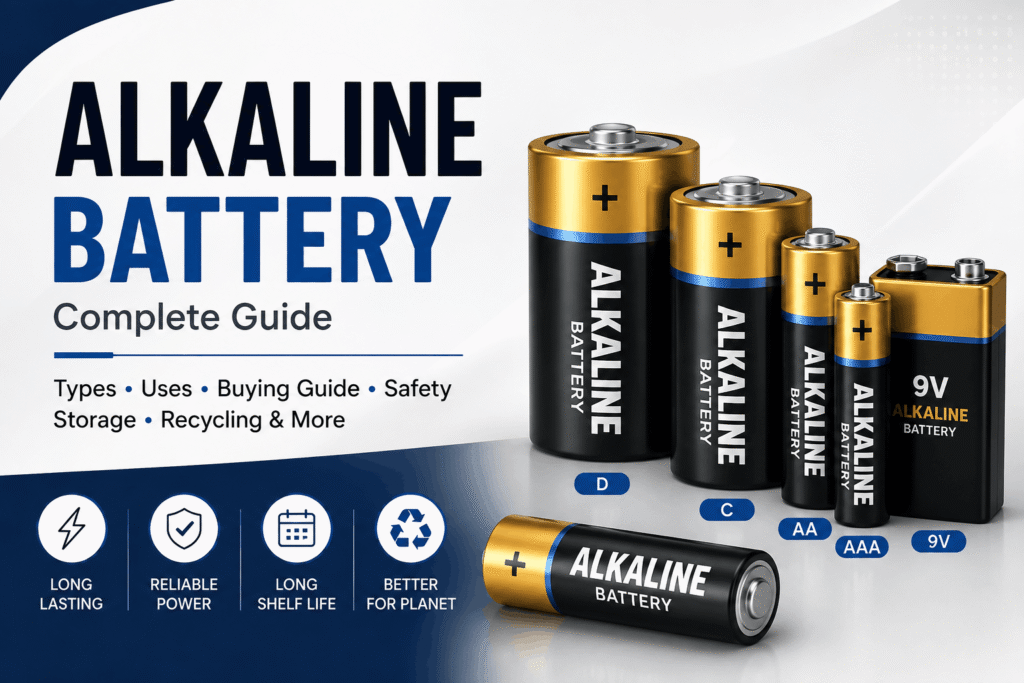
An alkaline battery is a non-rechargeable (primary) battery that uses zinc and manganese dioxide as its main active materials, with an alkaline electrolyte. Most alkaline batteries provide a nominal voltage of 1.5 volts and are commonly available in sizes such as AA, AAA, C, D, and 9V.
Their capacity varies by size, brand, and discharge conditions; for example, an alkaline AA battery typically provides several thousand mAh under specified test conditions. They are widely used in remote controls, clocks, toys, flashlights, wireless accessories, and other everyday devices.
Properly stored alkaline batteries can have a shelf life of several years, depending on the manufacturer. Their main advantages are low cost, easy availability, good shelf life, and reliable performance. However, they are not designed for recharging, and they can eventually leak, especially when old, damaged, or improperly stored.
Alkaline Battery Quick Facts
| Feature | Alkaline Battery |
|---|---|
| Battery type | Primary (non-rechargeable) battery |
| Nominal voltage | 1.5V per cell |
| Common sizes | AA, AAA, C, D, and 9V |
| Chemistry | Zinc and manganese dioxide |
| Electrolyte | Potassium hydroxide (alkaline electrolyte) |
| Rechargeable? | No — standard alkaline batteries are designed for single use |
| Capacity | Varies by size, brand, and discharge conditions |
| Typical applications | Remote controls, clocks, toys, flashlights, wireless accessories, and other everyday electronics |
| Shelf life | Typically several years when stored properly; varies by manufacturer |
| Main advantages | Affordable, widely available, good shelf life, and reliable for many everyday devices |
| Main disadvantages | Not rechargeable, capacity varies with load, and may leak as they age or when improperly used or stored |
Alkaline battery meaning: Why it’s called “alkaline”
The word “alkaline” refers to the type of electrolyte used inside the battery. In a standard alkaline-manganese dioxide battery, the electrolyte is an aqueous alkali metal hydroxide solution, commonly potassium hydroxide (KOH).
The electrolyte allows ions to move inside the cell while the electrochemical reactions at the electrodes generate electrical energy. During normal operation, zinc is oxidized at the anode while manganese dioxide is reduced at the cathode. This reaction produces the electrons that flow through the external circuit and power the connected device.
This alkaline electrolyte is also a key difference from traditional zinc-carbon batteries, which use an acidic electrolyte system based on ammonium chloride and/or zinc chloride.
Is an Alkaline Battery a Primary or Secondary Battery?
A standard alkaline battery is a primary battery, meaning it is designed primarily for one-time use rather than repeated charging.
A primary battery undergoes an electrochemical reaction that is not designed to be conveniently reversed by applying an external charging current. Once an alkaline battery has been substantially discharged, it should normally be replaced rather than recharged.
A secondary battery, on the other hand, is specifically designed to be rechargeable. Examples include NiMH (nickel-metal hydride) and lithium-ion batteries.
It is important not to confuse standard alkaline batteries with products specifically marketed as rechargeable alkaline batteries. Their construction and intended use can differ. For ordinary disposable alkaline batteries, attempting to recharge them is not recommended because it can lead to leakage, rupture, or other safety problems.
Alkaline vs. Older Zinc-Carbon Batteries
Alkaline batteries were developed as an improvement over the older zinc-carbon battery technology. Although both systems use zinc and manganese dioxide in their electrochemistry, their electrolyte systems and construction differ.
The alkaline system generally provides higher capacity under many discharge conditions, along with advantages such as longer shelf life, better leakage resistance, and better low-temperature performance compared with conventional zinc-carbon cells. Duracell notes that alkaline cells can provide substantially greater ampere-hour capacity than zinc-carbon cells under high and continuous drain conditions.
| Feature | Alkaline Battery | Zinc-Carbon Battery |
|---|---|---|
| Battery type | Primary | Primary |
| Typical cell voltage | 1.5V | 1.5V |
| Negative electrode | Zinc | Zinc |
| Positive electrode | Manganese dioxide | Manganese dioxide |
| Electrolyte | Alkaline hydroxide, commonly KOH | Typically ammonium chloride/zinc chloride based |
| Capacity | Generally higher | Generally lower |
| Shelf life | Generally longer | Generally shorter |
| Leakage resistance | Generally better | Generally poorer |
| Low-temperature performance | Generally better | Generally poorer |
Overall, an alkaline battery is best understood as a 1.5V-class disposable electrochemical cell that uses zinc, manganese dioxide, and an alkaline electrolyte to produce electrical energy. Its combination of affordability, availability, shelf life, and practical performance is why it remains common in everyday battery-powered devices.
Types of Alkaline Batteries
Alkaline batteries can be classified by their size, form factor, and intended application. While most alkaline batteries use a similar zinc–manganese dioxide chemistry with a potassium hydroxide (KOH) electrolyte, they are available in different physical formats and configurations.
Cylindrical Alkaline Batteries
These are the most common alkaline batteries used in everyday electronic devices.
| Battery Type | Nominal Voltage | Common Applications |
|---|---|---|
| AAA (LR03) | 1.5V | Remote controls, wireless mice, small electronics |
| AA (LR6) | 1.5V | Toys, flashlights, cameras, household devices |
| C (LR14) | 1.5V | Toys, lanterns, portable electronics |
| D (LR20) | 1.5V | High-drain flashlights, lanterns, larger devices |
9V Alkaline Batteries
A 9V alkaline battery contains multiple small cells connected internally to provide a nominal 9 volts. It is commonly used in smoke detectors, alarms, test equipment, and some audio devices.
Button and Coin-Style Alkaline Batteries
Small alkaline button cells are designed for compact, low-power devices such as calculators, clocks, toys, and small electronic instruments. They are available in several standardized sizes and typically provide around 1.5V, depending on the specific cell.
Rechargeable Alkaline Batteries
A rechargeable alkaline battery (secondary) is an alkaline-based battery specifically designed to be recharged and reused. Rechargeable alkaline batteries are a separate category from conventional alkaline batteries. Standard alkaline batteries are primary cells intended for single use, They are designed to tolerate a limited number of recharge cycles, whereas standard alkaline batteries are primary, non-rechargeable batteries.
They are commonly available in familiar sizes such as AA and AAA and may look similar to ordinary alkaline batteries. However, they should only be recharged using a charger specifically recommended by the manufacturer.
Industrial and Professional Alkaline Batteries
Industrial-grade alkaline batteries are manufactured for applications where longer storage life, consistent performance, and reliability are important. They are commonly used in security systems, industrial equipment, emergency devices, and professional electronics.
Important: Different alkaline battery types generally share the same basic chemistry, but their size, capacity, current-delivery capability, construction, and intended application can differ significantly.
How Does an Alkaline Battery Work?
An alkaline battery works by converting chemical energy into electrical energy through an electrochemical reaction. Inside the cell, zinc acts as the anode, while manganese dioxide acts as the cathode. An alkaline electrolyte, usually potassium hydroxide (KOH), allows ions to move inside the battery.
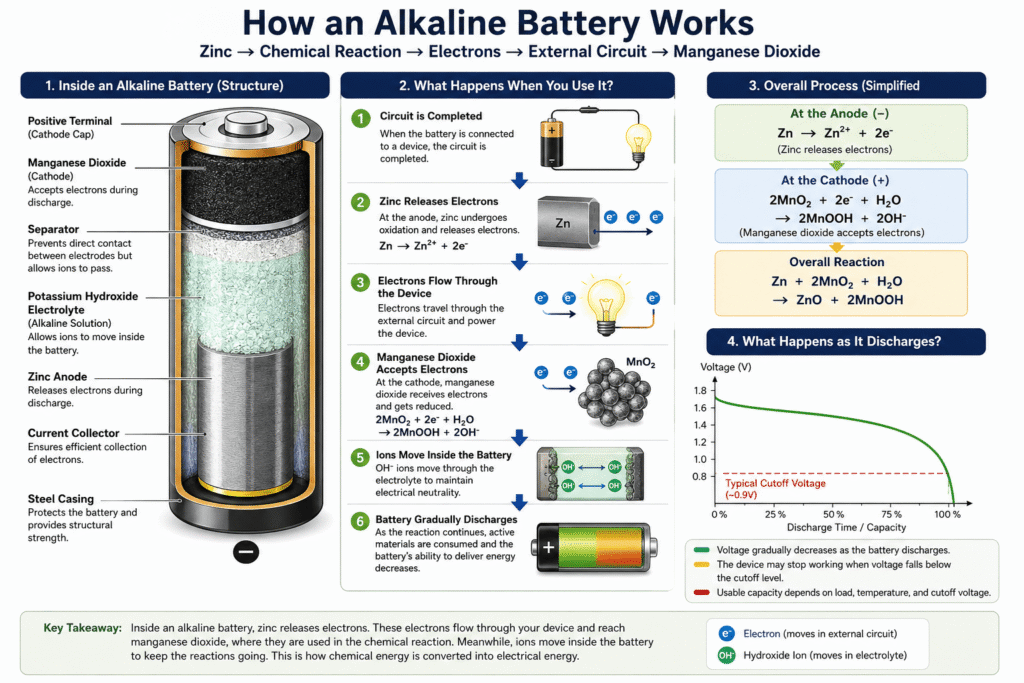
When you connect an alkaline battery to a device, the chemical reaction begins. Zinc releases electrons, and those electrons travel through the external circuit toward the positive terminal. The movement of these electrons creates the electrical current that powers the device.
In simple terms, the process can be understood as:
Zinc → chemical reaction → electrons → external circuit → manganese dioxide
The battery continues producing electricity as long as the electrochemical reactions can continue effectively and the device draws current.
Main Components of an Alkaline Battery
An alkaline battery contains several components that work together to produce and control the flow of electrical energy.
1. Zinc Anode
The zinc anode is the negative electrode of an alkaline battery. During discharge, zinc undergoes oxidation and releases electrons.
These electrons cannot simply travel directly through the battery from the zinc to the manganese dioxide. Instead, when an external circuit is connected, they flow through the connected device, producing useful electrical energy.
2. Manganese Dioxide Cathode
Manganese dioxide (MnO₂) forms the main active material of the positive electrode, or cathode.
During discharge, manganese dioxide participates in the reduction reaction and accepts electrons arriving through the external circuit. This reaction is an essential part of converting the battery’s stored chemical energy into electricity.
3. Potassium Hydroxide Electrolyte
The electrolyte in a conventional alkaline battery is typically potassium hydroxide (KOH).
Unlike the electrodes, the electrolyte is not simply an external pathway for electrons. Instead, it provides an ionic pathway inside the cell, allowing ions to move between the electrode regions and helping maintain the electrochemical reactions.
The electrolyte therefore plays a critical role in allowing the battery to continue operating while the electrons travel through the external circuit.
4. Separator
The separator is a porous insulating material placed between the anode and cathode.
Its main job is to help prevent the electrodes from making direct electrical contact, which could cause an internal short circuit. At the same time, it allows the necessary ionic movement through the electrolyte.
In other words, the separator helps keep the positive and negative electrode materials physically separated while still allowing the electrochemical process to function.
5. Steel Casing
The steel casing provides the battery with mechanical protection and helps contain its internal materials.
It also contributes to the overall structural integrity of the cell. Depending on the battery design, parts of the casing may also participate in the electrical connection to the battery terminals.
6. Current Collector
The current collector provides a conductive path between the active electrode material and the battery terminal.
In an alkaline cell, the current-collection system is designed to efficiently transfer electrical current while maintaining good contact with the electrode materials.
What Happens Inside an Alkaline Battery When You Use It?
When you insert an alkaline battery into a device and complete the electrical circuit, several processes occur simultaneously.
Step 1: The Circuit Is Completed
When you turn on a device, its electrical circuit becomes connected to the battery’s positive and negative terminals.
This creates a path for electrons to flow through the external circuit.
Step 2: Zinc Releases Electrons
At the negative electrode, zinc undergoes an oxidation reaction.
In simplified terms:
Zinc → zinc-containing reaction products + electrons
The released electrons move away from the negative terminal and enter the external circuit.
Step 3: Electrons Flow Through the Device
The electrons travel through the device’s electrical circuit.
As they move through components such as a motor, LED, electronic circuit, or other load, their electrical energy is converted into useful output.
For example:
- A motor converts electrical energy into mechanical motion.
- An LED converts electrical energy into light.
- A remote control uses the electrical energy to operate its electronic circuitry.
Step 4: The Cathode Reaction Consumes Electrons
After passing through the external circuit, electrons reach the positive terminal and participate in the reduction reaction involving manganese dioxide.
The cathode reaction allows the overall electrochemical process to continue.
Step 5: Ions Move Inside the Battery
While electrons travel through the external circuit, ions move through the electrolyte inside the battery.
This internal ionic movement helps maintain electrical neutrality and allows the electrode reactions to continue.
This distinction is important:
Electrons flow through the external circuit; ions move through the electrolyte inside the battery.
Step 6: The Active Materials Gradually Change
As the battery continues to discharge, the active chemical materials are gradually consumed or converted into reaction products.
As a result, the battery’s ability to deliver electrical energy eventually decreases.
The battery does not suddenly “lose all its electricity” at once. Its voltage and ability to deliver useful current generally decline as the discharge progresses, although the exact behavior depends on the battery design and the connected load.
What Happens When an Alkaline Battery Gets Low?
As an alkaline battery discharges, the available active materials decrease and the battery’s internal characteristics change. Its terminal voltage can gradually fall, and its ability to provide sufficient current to the device becomes increasingly limited.
A low-drain device such as a wall clock may continue working even when the battery is no longer capable of powering a high-current device effectively.
This is why battery capacity is not simply a fixed amount of mAh that every device can use. The usable capacity depends on factors such as discharge current, cutoff voltage, temperature, and battery construction.
Understanding this behavior is especially important when comparing alkaline batteries with rechargeable batteries or estimating how long an alkaline AA or AAA battery will last.
Alkaline Battery Voltage, Capacity & Sizes
We are already know that alkaline batteries are commonly available in several standardized sizes, including AAA, AA, C, D, and 9V. Most cylindrical alkaline cells have a 1.5V nominal voltage, while a standard 9V alkaline battery has a nominal voltage of 9V. However, actual voltage changes during discharge and depends on the load, temperature, and battery condition.
Battery capacity is measured in milliamp-hours (mAh), but there is no single mAh rating for every alkaline battery. Capacity varies with battery size, manufacturer, discharge current, temperature, and cutoff voltage. Larger cells generally provide more capacity than smaller cells, although the actual runtime depends on the device and operating conditions.
Alkaline Battery Voltage, Capacity and Size Chart
| Size | Nominal Voltage | Approx. Dimensions | Typical Capacity* | Common Uses |
|---|---|---|---|---|
| AAA (LR03) | 1.5V | 44.5 × 10.5 mm | ~400–1,250 mAh | Remotes, clocks |
| AA (LR6) | 1.5V | 50.5 × 14.5 mm | ~1,500–3,200 mAh | Toys, electronics |
| C (LR14) | 1.5V | 50 × 26.2 mm | ~6,000–9,000 mAh | Flashlights, radios |
| D (LR20) | 1.5V | 61.5 × 34.2 mm | ~10,000–21,000 mAh | High-drain devices |
| 9V | 9V | ~48.5 × 26.5 × 17.5 mm | ~360–600 mAh | Smoke alarms, detectors |
*Capacity figures are approximate and can vary significantly depending on the manufacturer, discharge current, temperature, and cutoff voltage. They should not be treated as universal ratings.
AA vs AAA Alkaline Battery
AA and AAA alkaline batteries both have a 1.5V nominal voltage, but they differ in physical size and capacity. An AA battery is larger and generally provides greater capacity and longer runtime than an AAA battery.
Therefore, AA and AAA batteries are not normally interchangeable. Always use the battery size specified by the device manufacturer.
C vs D Alkaline Battery
C and D alkaline batteries are both 1.5V, but D batteries are physically larger and generally have significantly higher capacity. C batteries are commonly used in radios and flashlights, while D batteries are often preferred for devices that require longer runtime or higher energy capacity.
Can You Replace AA With AAA?
Not usually. Although both are rated at 1.5V, an AAA battery is smaller and typically has less capacity than an AA battery. It may not fit the battery compartment correctly and can provide shorter runtime.
A physical adapter may allow an AAA battery to fit an AA compartment in some devices, but the adapter does not increase the AAA battery’s capacity. For reliable operation, follow the battery size recommended by the device manufacturer.
How Long Do Alkaline Batteries Last?
The runtime of an alkaline battery depends mainly on device power consumption, battery capacity, discharge rate, usage pattern, temperature, and battery age. A low-drain device may run for months or years, while a high-drain device can use the same battery within hours or days.
It is also important to distinguish runtime from shelf life. Runtime is how long a battery powers a device after installation, while shelf life is how long an unused battery can remain stored while retaining useful performance.
Typical Alkaline Battery Life
| Device | Typical Usage | Approximate Battery Life* |
|---|---|---|
| Remote control | Low, intermittent | Months to years |
| Wall clock | Very low, continuous | Around 1 year or longer |
| Flashlight | Moderate/high | Hours to days |
| Toy | Moderate/high, intermittent | Hours to weeks |
| Wireless mouse | Low, intermittent | Weeks to many months |
*Approximate examples only. Actual runtime varies by battery size, brand, device, current draw, temperature, and usage.
How Long Do Alkaline Batteries Last in Storage?
Unused alkaline batteries typically have a shelf life of several years, depending on the manufacturer and storage conditions. Keep them in a cool, dry place and check the expiration or best-before date on the packaging.
High temperatures can accelerate degradation, while very old batteries have a greater risk of leakage.
What Affects Alkaline Battery Life?
Two people can get very different runtimes from the same alkaline battery because battery life depends on several variables.
| Factor | Effect on Battery Life |
|---|---|
| Current draw | Higher current generally reduces usable capacity |
| Device type | High-power devices drain batteries faster |
| Battery capacity | Higher capacity can provide longer runtime |
| Temperature | Extreme temperatures can reduce performance |
| Battery age | Older batteries may provide less usable capacity |
| Usage pattern | Continuous use drains batteries faster |
| Cutoff voltage | Higher cutoff can leave some battery capacity unused |
The key point is that mAh is not a guaranteed runtime. The same battery can deliver different amounts of usable capacity depending on how it is discharged.
Alkaline Battery Applications
What Are Alkaline Batteries Used For?
Alkaline batteries are widely used in everyday low-to-moderate-drain electronics because they are affordable, widely available, and have good storage life.
| Application | Common Battery Sizes |
|---|---|
| Remote controls | AAA, AA |
| Clocks | AA, AAA |
| Toys | AA, AAA, C, D |
| Flashlights | AA, AAA, C, D |
| Wireless keyboards | AA, AAA |
| Wireless mice | AA, AAA |
| Radios | AA, C, D |
| Cameras | AA, AAA in compatible models |
| Smoke alarms | 9V in compatible models |
Best Uses for Alkaline Batteries
Alkaline batteries are well suited to devices that:
- Have low-to-moderate power requirements
- Are used intermittently
- Need batteries with good shelf life
- Do not require rechargeable cells
- Specifically recommend alkaline batteries
Choosing the Right Alkaline Battery for the Application
The best alkaline battery is not necessarily the one with the highest advertised mAh rating.
Instead, consider:
- Battery size — AA, AAA, C, D, or 9V.
- Required voltage — make sure it matches the device specification.
- Power consumption — high-drain devices may need a battery designed for that application.
- Expected runtime — compare manufacturer discharge data where available.
- Usage frequency — occasional and continuous-use devices have different requirements.
- Storage conditions — temperature can affect performance and shelf life.
- Manufacturer recommendation — always take the device manufacturer’s instructions as the final compatibility reference.
When Should You NOT Use an Alkaline Battery?
An alkaline battery may not be the right choice when a device requires another chemistry, a rechargeable battery, or a different voltage. Frequently used high-drain devices may also benefit from rechargeable NiMH or another chemistry designed for that application.
Always follow the device manufacturer’s battery recommendations rather than choosing a replacement based only on physical size or mAh.
Alkaline vs Other Battery Types
Alkaline batteries are popular because they are affordable, widely available, and have good shelf life. However, other battery chemistries can be better depending on voltage, energy density, rechargeability, discharge rate, and application.
| Battery Type | Typical Voltage | Rechargeable? | Key Advantage | Common Limitation |
|---|---|---|---|---|
| Alkaline | 1.5V | No | Affordable, good shelf life | Not rechargeable |
| Lithium | 1.5–3.7V* | Depends on type | High energy density, long life | Usually more expensive |
| NiMH | 1.2V | Yes | Reusable, good for frequent use | Higher self-discharge than some alternatives |
| Zinc-Carbon | 1.5V | No | Very inexpensive | Lower capacity and performance |
| LiFePO4 | ~3.2V | Yes | Long cycle life, stable chemistry | Much higher voltage per cell; not a direct alkaline replacement |
*“Lithium battery” covers several different chemistries and voltage ranges, so the exact voltage depends on the type.
Alkaline vs Lithium Batteries
Alkaline: Lower cost and widely available for everyday devices.
Lithium: Generally offers higher energy density, better performance in demanding conditions, and longer storage life. Lithium batteries are often preferred when low weight, long runtime, or extreme-temperature performance is important.
Best choice: Alkaline for everyday low-to-moderate-drain devices; lithium when higher performance or longer life justifies the additional cost.
Alkaline vs Rechargeable NiMH Batteries
Alkaline batteries provide approximately 1.5V nominal voltage, while rechargeable NiMH cells provide about 1.2V.
NiMH batteries can be recharged many times, making them economical for devices that consume batteries frequently. Alkaline batteries are more convenient for occasional use because they can be installed and discarded without charging.
Best choice: Alkaline for occasional use; NiMH for frequently used compatible devices.
Alkaline vs Zinc-Carbon Batteries
Both are typically 1.5V primary batteries, but alkaline batteries generally provide higher capacity, better high-drain performance, and longer shelf life than traditional zinc-carbon batteries.
Zinc-carbon batteries can be suitable for inexpensive, low-drain applications, while alkaline is generally the better all-purpose disposable option.
Best choice: Alkaline when longer runtime and better overall performance are needed.
Alkaline vs LiFePO4
LiFePO4 (lithium iron phosphate) is a rechargeable lithium battery chemistry with a nominal cell voltage of approximately 3.2V, so it is fundamentally different from a 1.5V alkaline cell.
LiFePO4 batteries offer high cycle life, good power capability, and stable operation, but they cannot normally replace alkaline batteries directly because their voltage and charging requirements are different.
Best choice: Alkaline for compatible disposable consumer devices; LiFePO4 for appropriately designed rechargeable battery systems.
Alkaline Battery Safety, Storage, Environmental Impact & Recycling
Alkaline Battery Safety
- Do not recharge standard alkaline batteries unless they are specifically labeled as rechargeable.
- Do not short-circuit, crush, puncture, or disassemble batteries.
- Keep batteries away from children and pets; swallowing a battery requires immediate medical attention.
- Do not mix old and new batteries or different battery types in the same device.
- Remove batteries from devices that will remain unused for extended periods to reduce the risk of leakage.
Proper Battery Storage
Store alkaline batteries in a cool, dry place at room temperature, away from direct sunlight, heat, and moisture. Keep them in their original packaging and avoid storing loose batteries where their terminals can contact metal objects.
Environmental Impact
Alkaline batteries contain materials that require proper waste management. Although modern alkaline batteries are designed with reduced hazardous-material content compared with older battery technologies, improper disposal still creates unnecessary environmental waste.
Alkaline Battery Recycling
Recycling availability depends on local regulations and collection programs. Do not assume all alkaline batteries belong in household recycling. Check your local waste authority or battery recycling program for the correct disposal method.
Tip: If a battery is leaking, avoid direct contact with the leaked material, place it in a safe container, and follow local battery-disposal guidance.
Conclusion
Alkaline batteries remain one of the most widely used primary battery technologies because they offer a practical balance of voltage, capacity, reliability, shelf life, and affordability. From AA and AAA cells to C, D, and 9V batteries, different sizes are designed for different power requirements.
Choosing the right alkaline battery depends on your device, power demand, expected runtime, and usage frequency. For everyday low-to-moderate power devices, a quality alkaline battery is often a reliable choice. For frequently used devices, rechargeable alternatives such as NiMH may provide better long-term value.
Understanding alkaline battery Chemistry, voltage, capacity, types, applications, safety, storage, and recycling helps you select the right battery and use it safely and efficiently.
huge and complete alkaline battery details, I loved this article.